When insurance payments rival the mortgage: Inside the 2026 homeowners insurance squeeze
SoFi reports rising homeowners insurance premiums are now rivaling mortgage payments, with many facing cancellations,
Press Release Disclaimer: This is a press release distributed through the XPR Media network. It has not been independently verified by our newsroom.



creveleo // Shutterstock
When insurance payments rival the mortgage: Inside the 2026 homeowners insurance squeeze
Homeownership seems to promise stability, with predictable monthly mortgage payments and protected assets. But in recent years, insurance changes — including withdrawals from high-risk states, policy nonrenewals, and premium spikes — have put many households on shakier ground.
To learn more about how policyholders are handling this financial pressure, SoFi surveyed 520 homeowners around the nation on April 13, 2026. The survey found many homeowners coping with swiftly rising premiums and the threat of policy cancellations; quite a few of their responses expose gaps in disaster readiness.
Key Points
- Insurance market disruptions, including premium spikes, policy nonrenewals, and carrier withdrawals from high-risk states, have left many homeowners on increasingly unstable financial ground.
- Nearly 2 in 5 homeowners nationwide saw premiums increase by more than 20% at a single renewal, while insurers have retreated from wildfire and hurricane-prone states.
- Hurricanes and severe windstorms rank as the greatest perceived threat to homes, yet more than half of homeowners spent nothing on damage-mitigating protective modifications in the past year.
- Household insurance costs rose 6.9% over a recent 12-month period, prompting 48% of owners to consider raising deductibles or switching to lower-tier policies to manage costs.
- Dropping coverage entirely risks triggering lender-imposed force-placed insurance policies that typically cost more and provide less protection than the original policy.
Hefty Home Insurance Costs Hammer Many, Especially Out West
First, the good news: Nearly half of the homeowners in SoFi’s survey report relative stability in their home insurance dealings. Nationwide, 49% report that not only have they been spared cancellations or nonrenewals, but they’ve also experienced stable premiums over the past three years.
That said, within the same period, almost 2 in 5 people (39%) across the country saw their insurance premiums increase by more than 20% at a single renewal.
SoFi
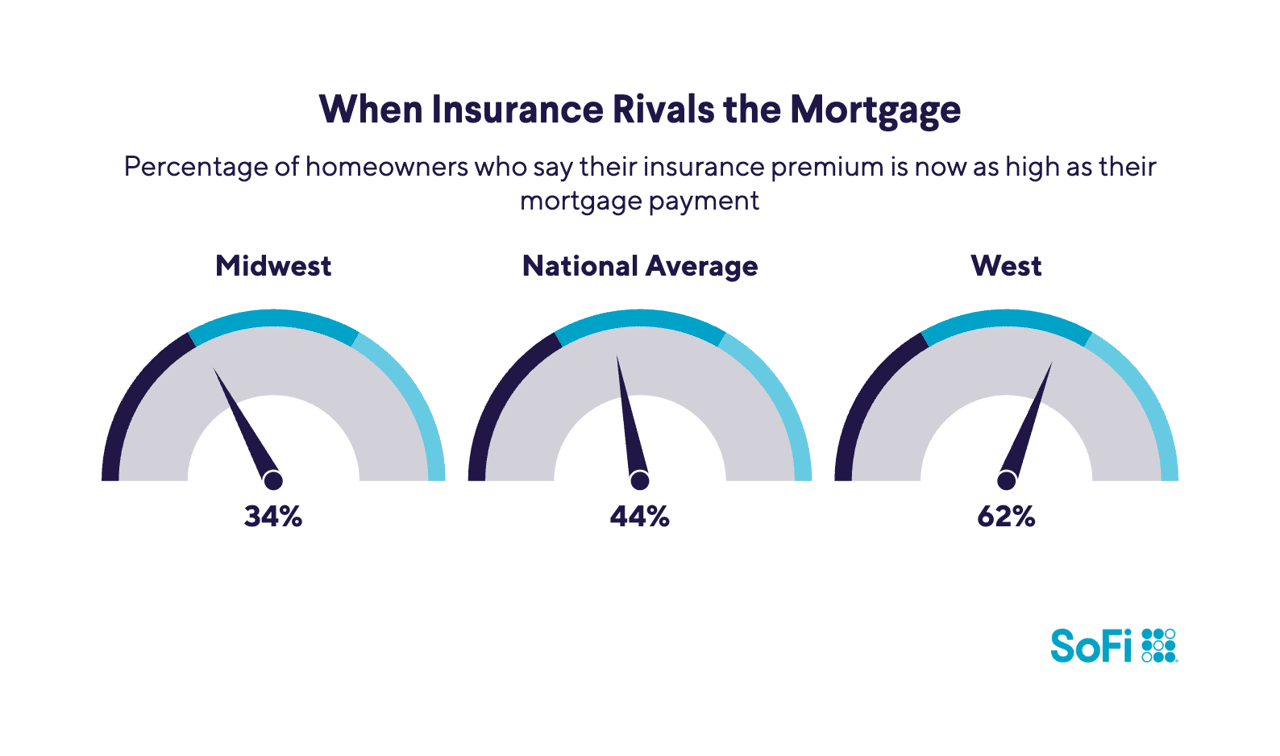
Even more — 44% — say their homeowners’ premiums are now large enough to rival their mortgage payments. That percentage varies by region, though, as do the cost of living and the risk of natural disasters. For example, in the Western states, 62% of respondents say their premiums are as high as mortgage payments; in the Midwest, only 34% do.
Nonrenewal or Cancellation Hits 1 in 4 Homeowners
Cost aside, for many homeowners, it’s tough holding on to a policy at all. Carriers have been retreating from states where the risk of wildfires and hurricanes is high. California, Oregon, Colorado, Arizona, and North Carolina have all seen recent cutbacks.
Regional data from the survey confirms the reports of insurers’ withdrawal. In the last two years, 38% of respondents living in Western states were hit with nonrenewal or cancellation notices due to “catastrophic risk” or property-specific concerns; they were forced to find new insurance carriers. In the Northeast, 31% were similarly cut off; one-quarter (26%) of that group were pushed onto state-backed plans.
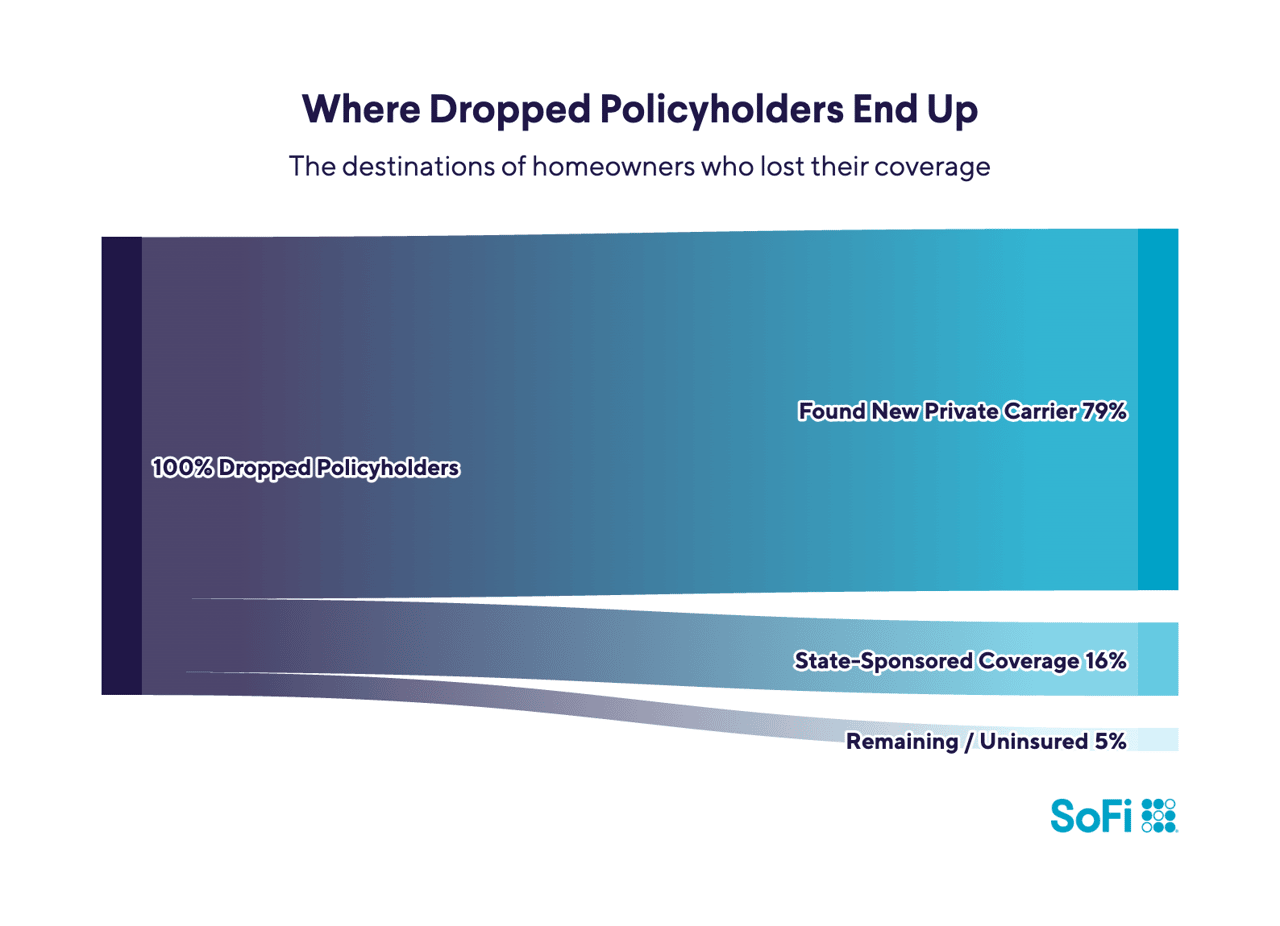
Nationally, rates were lower but still eye-poppingly high. Roughly one-quarter of homeowners (23%) were thrown off their homeowners’ insurance since 2024. Within that group, 79% had to find a new private carrier, while 16% ended up with state-sponsored coverage.
SoFi
Dangers Differ by Region, and Homeowners Don’t Always Prepare
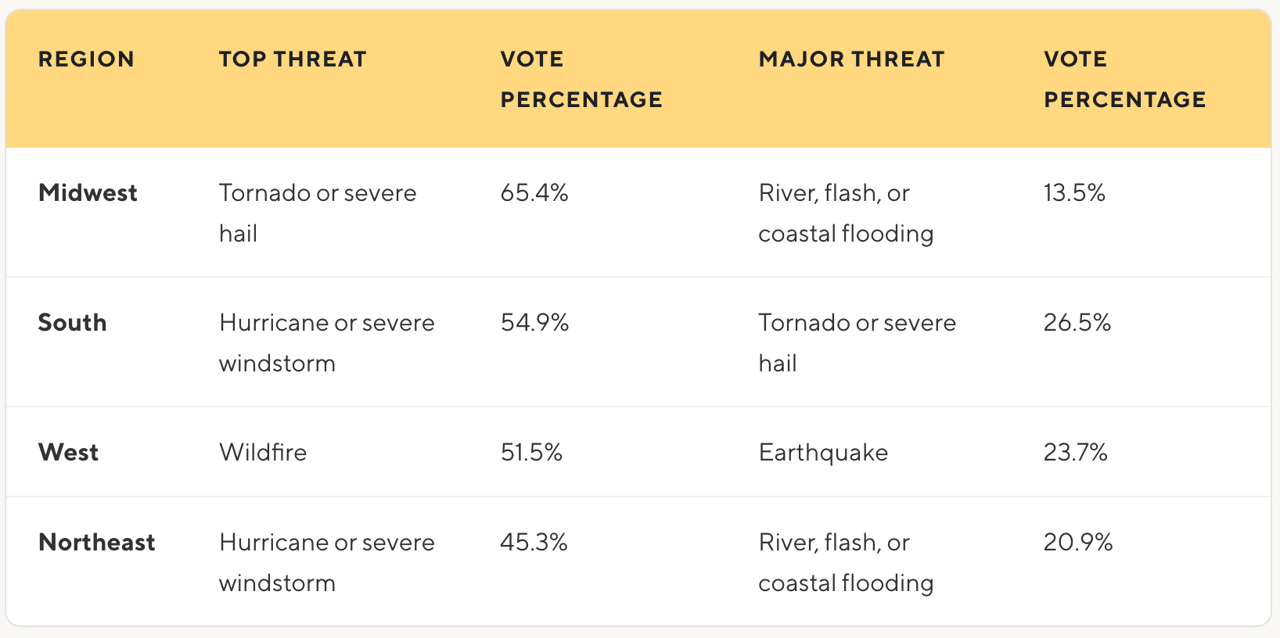
Natural disasters happen throughout the U.S. Asked to select the greatest threat to their home and property, respondents most often (35%) pointed to hurricanes and severe windstorms.
But as with everything related to real estate, location matters. Regionally, survey participants focused on tornadoes and flooding as well as hurricanes — except in the Western states, where people worried most about wildfires and earthquakes.
SoFi
For 13% of all respondents, nonhurricane flooding is the biggest risk. Yet within that group, only 41% had bought standalone flood insurance, with Southerners and Northeasterners most likely to do so (56% and 50%, respectively). More than 18% did not purchase it, in the belief that their homeowners policies cover water damage from floods. However, standard homeowners policies typically don’t.
Most Respondents Spent No Money This Year on Disaster-Mitigation Measures
The spotty adoption of flood insurance shows some homeowners’ inconsistency in managing disaster risk. Similarly, some respondents have been reluctant to invest in home improvements that can protect against expensive damage later — even when financial incentives are available.
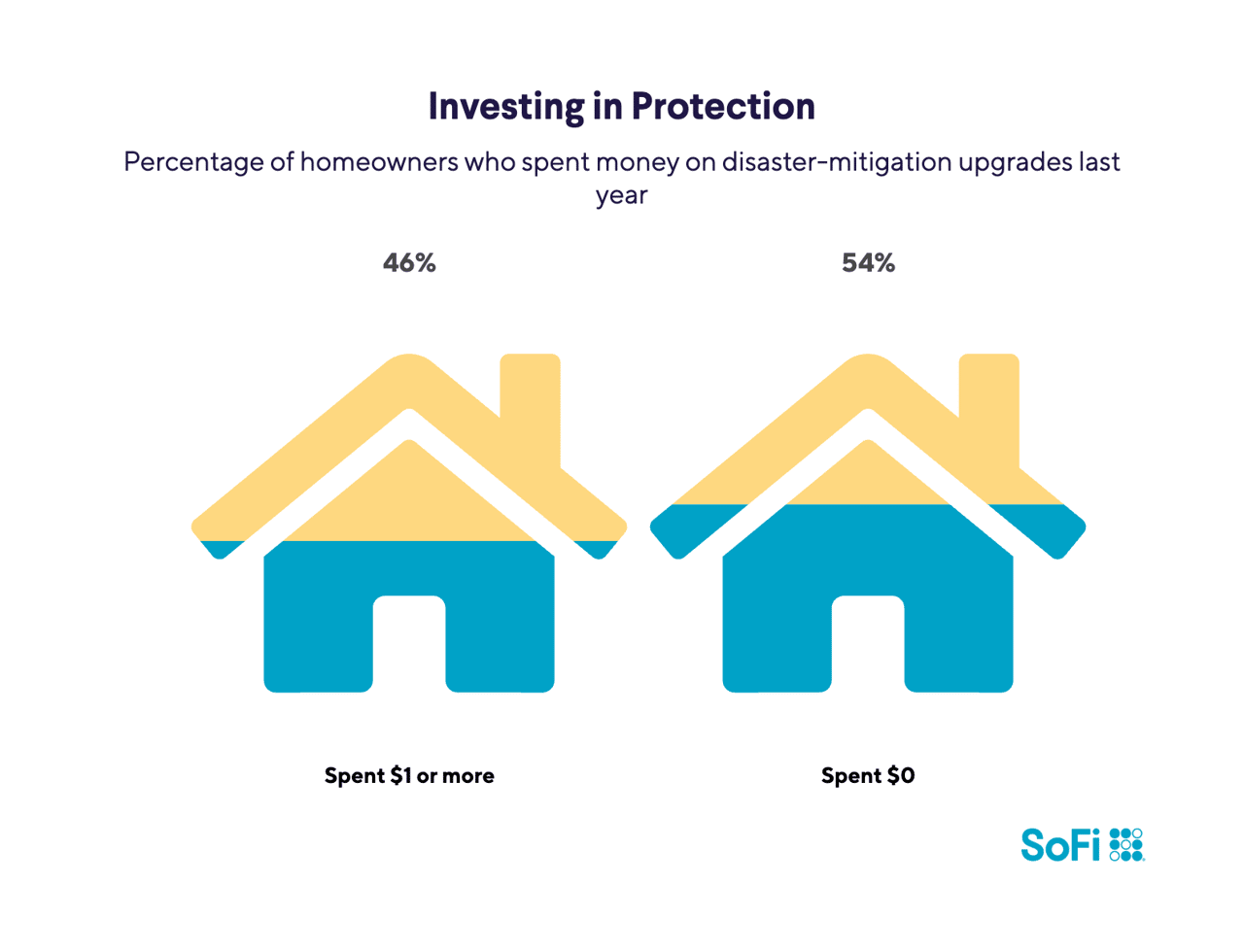
Within the past year, only 46% of respondents spent $1 or more on damage-mitigating home modifications like storm shutters and fire-resistant roofs. Most of those who did (61%) spent $2,500 or less; only 7% of them spent more than $10,000.
SoFi
Meanwhile, more than half (54%) spent no money at all on such protective measures, with 62% of this group expressing confidence that their existing policy would cover all weather-related rebuilding costs. (Again, in the event of flooding, this is very unlikely.)
About 14% believe their policy would not pay the full cost of rebuilding, and yet most of that group (71%) spent $0 on mitigation.
Insurance Discounts Encourage Home Hardening — But Some Resist
Working with state insurance regulators, some insurance carriers are reducing premiums for homeowners who take measures to fortify their homes against weather risk.
In the homeowners insurance survey, just over one-third (35%) of respondents said their insurers offer this type of discount. Accordingly, 85% of them spent money on damage-mitigation features last year.
Some people with access to mitigation discounts say that the cost of the upgrades exceeds the value of the discount. Even so, almost three-quarters (73%) of this group spent money to make their homes more resilient. (Discounts aren’t the only reason to invest in mitigation, of course — limiting damage reduces rebuilding costs.)
Almost half (45%) of all respondents don’t know whether their carriers offer mitigation discounts. Within this group, only 1 in 5 (19%) spent money on such measures.
Faced with Future Premium Hikes, Many Would Cut Coverage
According to May’s Consumer Price Index, household insurance costs rose 6.9% over the preceding 12 months, and the trend could well continue.
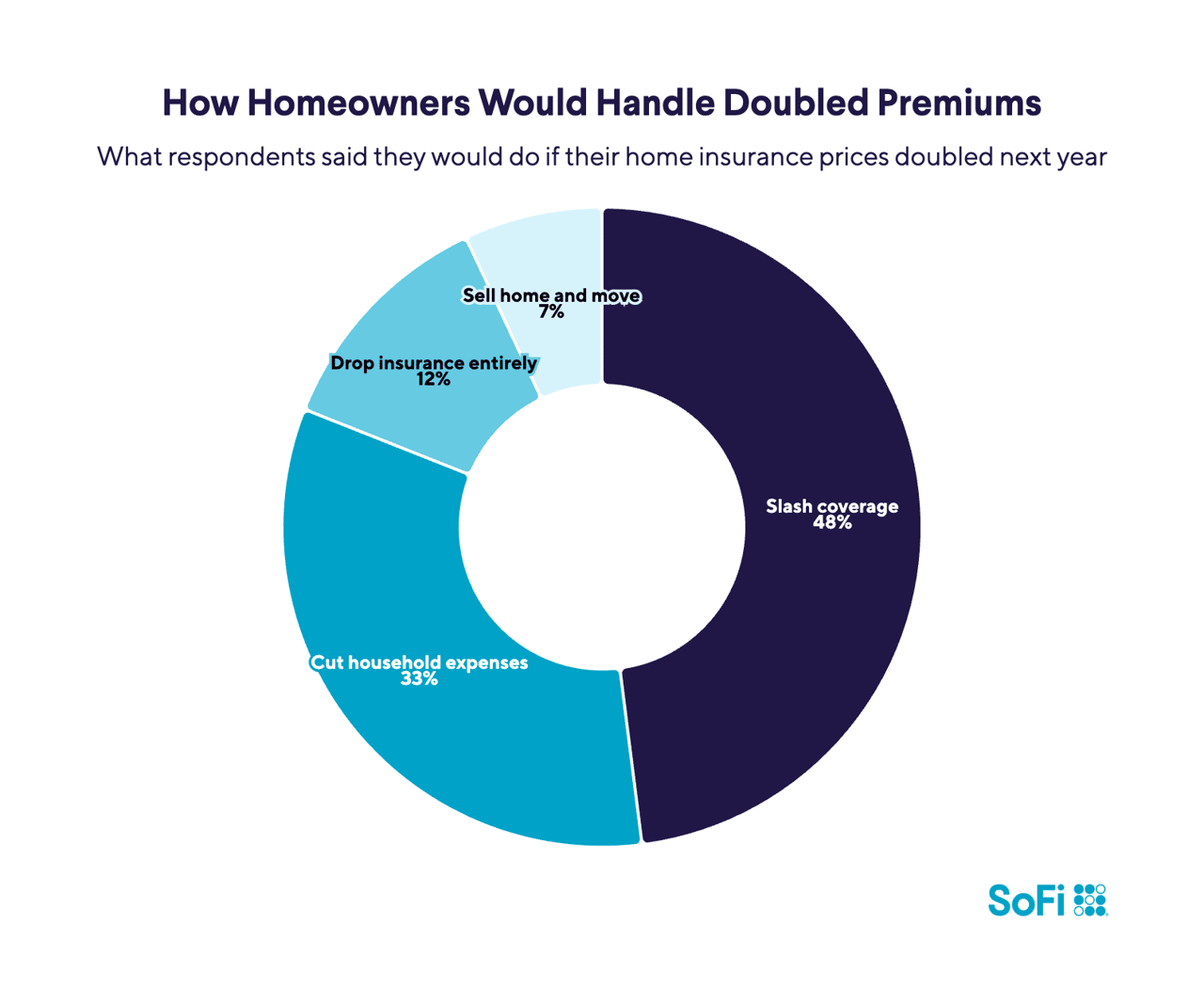
SoFi asked survey respondents to consider what they would do if insurance prices were to double next year. Nearly half (48%) said they would slash their coverage by raising deductibles or switching to lower-tier policies. One-third (33%) of them would absorb the cost by cutting household expenses, while 7% would opt to sell their home and move to a lower-risk area.
The remaining 12% would drop their insurance entirely. This aligns with existing data from the Insurance Information Institute. A 2023 study from III found that 12% of homeowners had not purchased insurance. Almost half of these households earn less than $40,000 per year, suggesting high insurance costs are often the reason.
SoFi
Doing without insurance, however, can be a false economy — even if disaster does not strike. By dropping a policy or letting it lapse, homeowners may trigger a mortgage provision that allows lenders to impose a “force-placed” insurance policy on the property. The new policy could easily cost more and cover less than the original one.
For that matter, the strategy of moving elsewhere may not be as easy as it sounds. Homeowners insurance is required by Fannie Mae and many mortgage lenders, so high insurance prices could constrain a tight real estate market even further. One-quarter of homeowners in the homeowners insurance survey (25%) are “very” or “extremely” concerned that their homes may become unsellable because of sky-high prices on insurance.
Most Would Welcome Government Help in Lowering Premiums
Consumers need relief, and many would welcome a helping hand from Washington.
One possibility is the creation of a federal government disaster fund to backstop private insurers and help lower consumer premiums. More than half (56%) of respondents say they’d support this type of program in order to help stabilize the market. A small minority (16%) think it would be an unfair subsidy to people living in high-risk zones.
Such a program strongly appeals to the people who are most concerned about high insurance costs hindering their home sale; they endorse it by a margin of more than 5-to-1. Even respondents who aren’t concerned at all about resale approve of the measure, though the ratio drops to about 2-to-1.
The Takeaway
Survey results show that, for many U.S. homeowners, rising insurance premiums rival mortgage payments; many policyholders face the threat of cancellations, especially in high-risk regions. Despite these growing costs, a significant number of people haven’t taken steps to protect their homes, often underestimating their true financial risk. More than half of homeowners support potential federal intervention to stabilize the market and dampen premium increases.
This story was produced by SoFi and reviewed and distributed by Stacker.