Wearable Medical Device Market to reach USD 167.8 Billion by 2035 at 14.2% CAGR
Wearable Medical Device Market to Surge from USD 44.5 Bn in 2025 to USD 167.8 Bn by 2035—By Remote Patient Monitoring
Press Release Disclaimer: This is a press release distributed through the XPR Media network. It has not been independently verified by our newsroom.
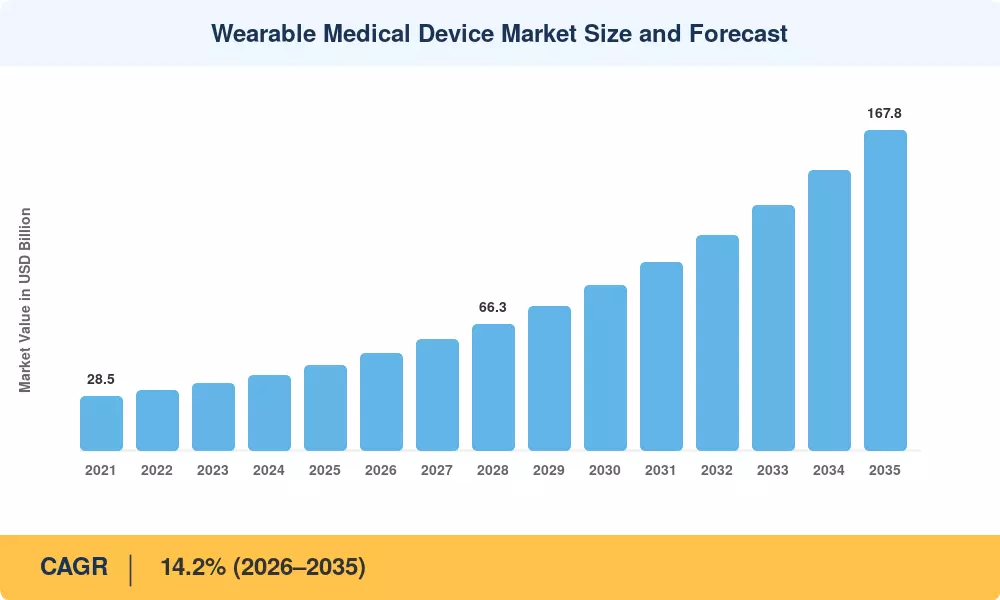

Wearable Medical Device Market to Surge from USD 44.5 Bn in 2025 to USD 167.8 Bn by 2035—By Remote Patient Monitoring Expansion, Chronic Disease Management
NY, CA, UNITED STATES, August 31, 2026 /EINPresswire.com/ — As per Market Research Future, the global Wearable Medical Device Market size is projected to reach USD 167.8 Billion by 2035 from USD 44.5 Billion in 2025, at a CAGR of 14.2% during the forecast period 2026–2035. North America captured approximately 36.5% of the market share in 2025, while Asia-Pacific is projected to be the fastest-growing region at a 17.3% CAGR .
The 14.2% CAGR is propelled by several converging forces. The expanding adoption of remote patient monitoring (RPM) and hospital-at-home models is creating sustained demand for wearable devices that enable continuous, real-time health data collection outside traditional clinical settings. The rising prevalence of chronic conditions such as diabetes, cardiovascular diseases, and respiratory disorders is driving the need for continuous glucose monitors, cardiac monitors, and other therapeutic wearables . Technological advancements in biosensors, AI-driven analytics, and miniaturization are making wearable medical devices more accurate, user-friendly, and clinically actionable.
Regulatory and policy initiatives are amplifying this momentum. The U.S. FDA has streamlined clearance pathways for digital health technologies, while the EU’s Medical Device Regulation (MDR) and Germany’s DiGA digital-health-app reimbursement framework are creating structured adoption pathways . In North America, expanded Medicare reimbursement for RPM services and hospital-at-home mandates are accelerating device adoption. In Europe, countries like Germany (15.3% CAGR), the Nordic countries (14.9% CAGR), and France (14.8% CAGR) are leading adoption through digital health funding and interoperability programs .
Request A Free Sample:
https://www.marketresearchfuture.com/sample_request/899
Key Market Trends & Growth Drivers
Remote Patient Monitoring and Home Healthcare Expansion
The home healthcare segment is emerging as a dominant application, driven by the increasing preference for receiving medical care in home settings, rising prevalence of chronic conditions requiring continuous monitoring, and growing adoption of wearable devices that enable real-time health tracking . Home healthcare solutions enhance patient convenience, reduce hospital visits, and support long-term disease management.
Chronic Disease Management and Continuous Monitoring
Wearable medical devices have grown phenomenally in terms of their usage for screening biological data, typically with wireless or remote communication . These devices support the management and treatment of several chronic diseases such as respiration, blood oxygen level, heart rate, and body fat. Continuous glucose monitors (CGMs) and cardiac monitoring devices are among the most widely adopted therapeutic wearables .
Technological Advancements in Biosensing
The integration of advanced biosensors, photoplethysmography, electrocardiography, and motion sensors is enabling more sophisticated health tracking and clinical-grade data collection . AI-driven analytics are transforming raw data into actionable insights for both patients and healthcare providers.
Ask for Customization:
https://www.marketresearchfuture.com/ask_for_customize/899
Market Segment Insights
BY DEVICE TYPE
Diagnostic & Monitoring Devices: Includes vital sign monitoring devices, neuromonitoring devices, glucose monitoring devices, sleep monitoring devices, and fetal monitoring & obstetric devices .
Therapeutic Devices: Includes rehabilitation devices, pain management devices, respiratory therapy devices, and insulin pumps .
BY APPLICATION
Remote Patient Monitoring: Significant segment driven by telehealth integration and chronic disease management.
Home Healthcare: Fastest-growing segment, supported by increasing preference for home-based care and continuous health tracking .
Sports & Fitness: Established segment with continued demand for activity and exercise tracking .
BY DISTRIBUTION CHANNEL
Online Channels: Growing segment driven by direct-to-consumer sales and e-commerce penetration.
Pharmacies: Traditional channel for therapeutic and diagnostic devices.
Hypermarkets: Established retail channel for consumer-grade wearables.
Read Detailed Insights:
https://www.marketresearchfuture.com/reports/wearable-medical-device-market-899
Regional Outlook
North America — Dominant Market (~36.5% Share, 2025)
North America leads the market, driven by RPM reimbursement policies, hospital-at-home mandates, and advanced healthcare infrastructure . The United States is the primary contributor, accounting for approximately 87.6% of the North American market . The U.S. market is driven by the growing prevalence of chronic conditions and consumer demand for health monitoring solutions. According to the NIH, by 2035, 35.66% of the U.S. adult population aged 50 and older will have at least one chronic condition .
Europe — Second Largest (~25.5% Share, 2025)
Europe holds the second-largest position, supported by MDR compliance frameworks and aging-population programs . Germany is leading adoption through its DiGA digital-health-app reimbursement framework at a 15.3% CAGR, while France’s Ségur du Numérique interoperability funding and the Nordic countries’ high digital literacy are driving growth at 14.8% and 14.9% CAGRs respectively . The prevalence of heart and circulatory diseases and an aging population are key demand drivers in the region .
Asia-Pacific — Fastest-Growing Region (17.3% CAGR, 2026–2035)
Asia-Pacific is the fastest-growing region, fueled by government digitization initiatives, manufacturing cost advantages, and increasing health consciousness . China dominates the region with 27,000 fitness clubs as of 2020, while rising health awareness is driving demand for affordable wearable technology . The Asia-Pacific market is growing at a tremendous pace because of the increasing incidence of chronic diseases and the rapid growth of health and fitness infrastructure .
South America — Growing Presence (USD 3.34 Billion, 2025)
Brazil leads the region with the second-highest number of health clubs (29,525), reflecting growing health consciousness and demand for wearable devices that track heart rate, sleep patterns, and physical activity . Insurance digitization and chronic-disease burden are key investment themes .
Middle East & Africa — Emerging Opportunity (~6.0% Share, 2025)
Beneficial government initiatives, such as Saudi Arabia’s Vision 2030 Quality of Life Objectives, are supporting sports and health projects, creating demand for wearable medical devices . Gulf sovereign health funds and mobile-first adoption are key investment themes .
Competitive Landscape
The Wearable Medical Device Market is competitive, with a mix of established healthcare giants and innovative technology companies focused on partnerships, collaborations, and product innovation .
KEY COMPANIES :
Apple Inc.
Medtronic PLC
Philips (Koninklijke Philips N.V.)
Abbott Laboratories
Dexcom, Inc.
GE Healthcare
Boston Scientific Corporation
OMRON Healthcare, Inc.
Fitbit Inc.
Huawei Technologies Co., Ltd.
Xiaomi Corp.
Samsung
Qualcomm Inc.
Recent Developments :
Google (May 2026): Introduced the Google Health app, Google Health Coach, and Fitbit Air, enabling users to integrate data from wearable devices, medical records, and health applications.
GE Healthcare: Expanded its Portrait Mobile monitoring solution, a wearable and wireless platform for continuous real-time patient monitoring.
Future Outlook: 2026–2035
The Wearable Medical Device Market is projected to reach USD 167.8 Billion by 2035, growing at a CAGR of 14.2%, driven by remote patient monitoring expansion, chronic disease management, and technological advancements in biosensing.
New opportunities lie in:
Integration of AI-driven predictive analytics for early disease detection and personalized health insights.
Expansion of continuous glucose monitoring and cardiac monitoring into broader patient populations.
Development of next-generation biosensors for multi-parameter health tracking.
Partnerships between technology firms and healthcare providers for integrated care ecosystems.
By 2035, wearable medical devices are expected to be a foundational element of modern healthcare delivery, transforming patient monitoring and chronic disease management.
More Related Research Insights:
https://www.marketresearchfuture.com/reports/drug-discovery-services-market-5870
https://www.marketresearchfuture.com/reports/urology-devices-market-1120
https://www.marketresearchfuture.com/reports/home-medical-equipment-market-8486
https://www.marketresearchfuture.com/reports/preclinical-imaging-market-7365
https://www.marketresearchfuture.com/reports/heart-rate-monitor-market-1370
https://www.marketresearchfuture.com/reports/tumor-ablation-market-7139
https://www.marketresearchfuture.com/reports/veterinary-ultrasound-market-6054
https://www.marketresearchfuture.com/reports/blood-transfusion-diagnostics-market-1126
https://www.marketresearchfuture.com/reports/hyperhidrosis-treatment-market-8475
https://www.marketresearchfuture.com/reports/hydrophobic-interaction-chromatography-market-6366
Market Research Future
Market Research Future
+1 855-661-4441
email us here
Legal Disclaimer:
EIN Presswire provides this news content “as is” without warranty of any kind. We do not accept any responsibility or liability
for the accuracy, content, images, videos, licenses, completeness, legality, or reliability of the information contained in this
article. If you have any complaints or copyright issues related to this article, kindly contact the author above.

Media gallery